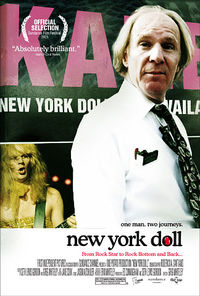
(Note: This discussion contains significant spoilers. Consider yourself warned if you haven't yet seen the movie.)
Like many documentaries, Greg Whiteley's film "New York Doll" traces its origins to a meeting so serendipitous that it could hardly be called anything but destiny. Whiteley, a newly married film student at a Los Angeles arts college, was introduced to Arthur "Killer" Kane shortly after attending church in his new ward. Kane was a former bass guitarist for the New York Dolls, a glam punk band that revolutionized the music world in the 1970s. The Dolls broke up in 1975, and Kane's personal and professional life went into a tailspin. Surprising everyone who ever knew him, he joined The Church of Jesus Christ of Latter-day Saints in 1989.
When Whiteley met Kane in 2001, Arthur was working in the Church's Family History Center near to the Los Angeles Temple. Kane told Whiteley all about his time with the Dolls - the music, the girls, the drugs - and confided in him his dream of someday being able to reunite with the band. In spring 2004, Arthur's wish was granted when Morrissey staged a reunion of the three surviving members of the band in London as part of his Meltdown Festival. Whiteley seized the opportunity to tell Arthur's story in film, and followed him with his camera to New York, London, and back home to L.A.
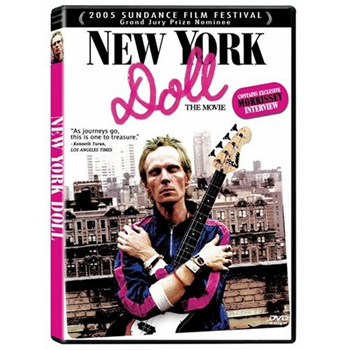
In an interview on the "Doll" DVD, Whiteley reveals that he shot close to 140 hours of footage, both on the road with Arthur and in interviews with Morrissey, Chrissie Hynde, Sir Bob Geldof, Iggy Pop, and others. "New York Doll" is thus a miracle of film editing, a 78-minute film without a single extraneous scene or dull moment.
The movie is able to strike just the right balance between personal story and "rockumentary." On the DVD Whiteley remarks that what he hoped to avoid was a VH1 "Behind the Music" clone, acknowledging that his first cut was centered far too much on the Dolls themselves: their rise and fall, their place in music history, and the 2004 reunion. Such a film would have found an audience only among a small nucleus of music fans; who else would care? However, by focusing on an individual person's story of redemption (spiritually, then musically), Whiteley was not only able to enlarge the scope of his audience, but also allow them to become emotionally invested in Kane's journey.
And what a journey it is. Arthur Kane is a man so genuine and free of guile that we almost regard him as a frail puppy, a creature motivated solely by a need to love and be loved by others. The years of hard living have taken a hard physical and mental toll on the man. In fact, he'd be quite the pathetic character if he weren't so matter-of-fact and down-to-earth about it all. We watch with amazement as our perspective on him changes: we regard him first with curiosity, then with sympathy, and finally with admiration. His sudden and inexplicable death from leukemia hits the audience like a brick wall, forcing us to again reevaluate what we think of his man. What appears to be a man's life as a "work in progress" suddenly stops, and we realize the actual masterpiece standing before us.
Because Arthur is so real and unaffecting, we slowly realize how "fake" everyone else in the film is. That's not an accusation of dishonesty; however, it's clear that everyone else in the film knows they're in a movie, and they stage their actions and responses to questions in a certain articulate and rehearsed way. Morrissey and Bob Geldof, for all the "perspective" they try to provide on Arthur's life, come across as completely off the mark. David Johansen (a.k.a. Buster Poindexter, and the Dolls' frontman) in particular looks like an absolute buffoon, a caricature of a human being. It becomes clear by the end of the film that none of these men really knew Arthur at all. They didn't know what truly made him happy. Whiteley wonderfully juxtaposes their bewilderment at Arthur's decision--to not continue touring with the Dolls after their reunion performance--with a shot of Arthur sitting in the back of an L.A. city bus, dressed for work in his long-sleeved white shirt and tie, with that goofy little grin on his face.
Why did Arthur want to play with the Dolls again? I don't believe it stemmed from a desire to relive the glory days of his punk rock youth. I am convinced it was much more about reconciling himself with his past to remove the burden of guilt from his mind. Once that pain was relieved, he was in heaven. Literally.
No good movie is ever too long. I wished this one was a little longer. I was left wanting a little more about Arthur's life after his conversion, but that's probably a subject of another film. As it stands, the movie does little to help those outside the LDS faith to understand the depth of his transformation, virtually assuring that he will remain an enigma to his friends and fans.
And there's one scene in the movie that sticks out to me as painfully contrived. Whiteley handed a Book of Mormon to one of the music personalities he was interviewing and had her read Mormon 9:21: "Behold, I say unto you that whoso believeth in Christ, doubting nothing, whatsoever he shall ask the Father in the name of Christ it shall be granted him; and this promise is unto all, even unto the ends of the earth." Because we as an audience immediately sense she doesn't really believe the words, it comes across as patronizing of LDS beliefs and Arthur's convictions. Whiteley should have let Arthur's bishop read the verse, as he was just about to do, rather than go for the unexpected twist of having a nonbeliever do it.
Note that I've said nothing about this film's place in the pantheon of LDS cinema. Without diving into greater detail (I'll save it for the discussion), I'll simply state that it stands at the top. I don't know if movies like this represent the future of LDS cinema, but it's a fine example that HaleStorm Entertainment, Excel Entertainment, and Main Street Movie Co. don't have a monopoly on the genre.