I highly recommend that you read the full article (though it is long), but I'll try to summarize the parts that seem very reminiscent of McCarthy to me.
The focus of the article is a well-respected Muslim educator, Debbie Almontaser, who tried to create a multi-ethnic school that would teach Arabic alongside English. This woman was known for making an effort to reach out to other ethnicities and religions. Though the woman was Muslim, the school did not teach the Islamic religion any more than the NY state curriculum required. And her effort to create a school that taught another language alongside English was not unusual--there were already 67 schools nearby that did a similar thing with languages like Russian, Spanish, and Chinese.
But the simple fact that she was Muslim doomed this plan. Her opposition first started in the form of an op-ed article written by Daniel Pipes. Mr Pipes admitted that he knew little about the school at the time, but had nonetheless stated in the article that the Arabic language is directly associated with Islamic beliefs, and therefore the school would be used to indoctrinate students (calling the school a "madrassa"). This article galvanized others who were nervous about the possibilities of an "Arabic" school. And thus started the "Stop the Madrassa Coalition."
Here are a few excerpts from the article about Mr Pipes:
In the aftermath of Sept. 11, critics of radical Islam focused largely on terrorism, scrutinizing Muslim-American charities or asserting links between Muslim organizations and violent groups like Hamas. But as the authorities have stepped up the war on terror, those critics have shifted their gaze to a new frontier, what they describe as law-abiding Muslim-Americans who are imposing their religious values in the public domain.
Do we not all try to impose some of our values on the public domain? After all, aren't all of our laws more or less a common acceptance of a certain value (say, robbery and murder are bad)?
Mr. Pipes and others reel off a list of examples: Muslim cabdrivers in Minneapolis who have refused to take passengers carrying liquor; municipal pools and a gym at Harvard that have adopted female-only hours to accommodate Muslim women; candidates for office who are suspected of supporting political Islam; and banks that are offering financial products compliant with sharia, the Islamic code of law.
The danger, Mr. Pipes says, is that the United States stands to become another England or France, a place where Muslims are balkanized and ultimately threaten to impose sharia.
“It is hard to see how violence, how terrorism will lead to the implementation of sharia,” Mr. Pipes said. “It is much easier to see how, working through the system — the school system, the media, the religious organizations, the government, businesses and the like — you can promote radical Islam.”
Mr. Pipes refers to this new enemy as the “lawful Islamists.”
They are carrying out a “soft jihad,” said Jeffrey Wiesenfeld, a trustee of the City University of New York and a vocal opponent of the Khalil Gibran school.
And, continuing on with Mr Pipes,
Mr. Pipes is perhaps best known for Campus Watch, a national initiative he created to scrutinize Middle Eastern programs at colleges and universities. The drive has accused professors of, among other things, being soft on militant Islam and sympathetic to the Palestinian cause. It has stirred widespread controversy and, in some cases, may have undermined professors’ bids for tenure.
I found this very interesting and decided to include it because Bryan received his undergraduate degree in Near Eastern Studies--studying both the Arabic language as well as some of the political issues in the Middle East. The part I found the most sad was the "sympathetic to the Palestinian cause." Bryan's studies did in fact make him more sympathetic to the cause--not condoning the violence whatsoever, but realizing that the fault really did lay on both sides. Both sides have had to deal with terror and have been victimized. Bryan's classes informed and tried to help him understand. But would Mr Pipes have considered those classes offensive?
Mr. Pipes ... noted in an interview that monitors of radical Islam have increasingly trained their sights on nonviolent Muslim-Americans.
“They don’t throw bombs, but they create political cover for ideological support of this jihadi movement,” he said.
Mr. Pipes places Muslims in three categories, he said: those who are violent, those who are moderate and those in the middle. It is this middle group, he argued, that now poses the greatest threat to American values.
“Are these people who are not using violence but who are not fully enthusiastic about this country and its mores, its culture — are they on our side or are they on the other side?” he asked.
This is the particular part that caught my eye, especially the last quote. Frankly, I'm not fully "enthusiastic" about the current American culture--there are a lot of problems, first on my mind being pornography and general permissiveness. Does that mean that I am a threat? That I am trying to "take down America" and should be stopped?
The article then listed the tactics Mr Pipes used, including misquoting and/or selectively choosing to leave out important parts of quotes to twist the meaning:
He cited an article in which she was quoted as saying about 9/11, “I don’t recognize the people who committed the attacks as either Arabs or Muslims.” (As The Jewish Week later reported, Mr. Pipes left out the second half of the quote: “Those people who did it have stolen my identity as an Arab and have stolen my religion.”)
And then the article continues:
The Stop the Madrassa Coalition focused primarily on Ms. Almontaser as a strategy, said Mr. Pipes, because the group could get little information about the school itself. The coalition quickly publicized several discoveries. Ms. Almontaser had accepted an award from the Council on American-Islamic Relations, a national Muslim organization that critics claim has ties to terrorist groups (an assertion the group adamantly denies). In news articles, Ms. Almontaser had been critical of American foreign policy and police tactics in fighting terrorism. She also gave $2,000 to Representative Cynthia A. McKinney of Georgia, whom Mr. Pipes and others have characterized as an Islamist sympathizer. (Ms. McKinney, who is no longer in office and did not respond to requests for an interview, has had a strong following among Arab-Americans in part because of her criticism of the Patriot Act.)
Critics of the Madrassa Coalition say its tactics are typical of campaigns singling out Muslims: They lean heavily on guilt by association. The nuances of the claims against Ms. Almontaser were lost as the controversy lit up the blogosphere, said Chip Berlet, a senior analyst at Political Research Associates, a liberal organization outside Boston that studies the political right. One Web site, MilitantIslamMonitor.org, displayed photographs of Ms. Almontaser wearing her hijab in different styles, suggesting that she had undergone a public relations makeover to “disguise” her “Islamist agenda.” The criticism of Ms. Almontaser and the school spread to newspapers, eliciting negative editorials in The Daily News and The New York Sun.
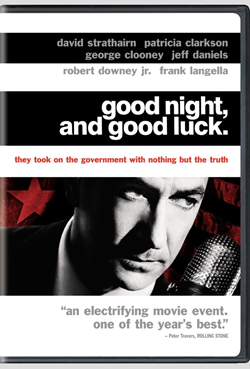
Reading this, I just kept having flashes back to scenes in Good Night and Good Luckof McCarthy accusing people--including Murrow himself--of being subversive because they were "associated" with a "subversive" group (though it wasn't rare that McCarthy himself had been the only one to label the group as such).
Once again, we have someone playing on other's fear and paranoia to promote their own purposes, someone twisting the truth, misquoting, and basically being given an open field to blast his opponents. Once again, we have someone who apparently isn't interested in researching facts beyond what is convenient and who exploits the ignorance of others. And, once again, we have someone doing a fairly good job of ruining the life of the targeted person, who is (as far as I can tell) completely innocent. I know this man does not currently have the national power that McCarthy did, but he is also not alone in his views and efforts--and, with the overall distrust our country has with Islam in general, I can see these attacks coming more often in the future unless something is done to stop them.
Anyone else find this eerily similar?