As the film begins, we are introduced to a cavalcade of journalists, network and advertising executives gathered together in a smoky banquet room to honor one of their own - and, in a way, themselves.
The year is 1958. Senator Joseph McCarthy has been dead for one year. His crusade to rid the country of supposed Communist elements is now four years past. It is a triumph for broadcast journalism, for the Columbia Broadcasting System, and especially for reporter Edward R. Murrow, the banquet's honoree.
But amid all the schmoozing and laughter, the picture-taking and merriment, Murrow is nowhere to be found.
We first see him in silhouette, nervously smoking a cigarette, as he waits backstage for his cue to come to the lectern and deliver the keynote address. After stepping to the microphone, he proceeds to deliver an unbridled castigation of his audience for the manner in which they are perverting the medium of television by using it to entertain rather than educate and inform.
Those first few minutes tell you everything you need to know about Edward R. Murrow.
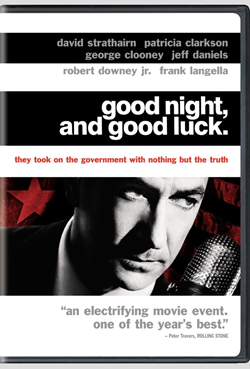
George Clooney's Good Night, and Good Luck. (subsequently referred to as GNAGL) is a remarkably restrained telling of the Murrow versus McCarthy incident that played out in the living rooms of America during March-April 1954. At barely 90 minutes in length, there's little time given to establish the cast of characters (Murrow, McCarthy, newsman Don Hollenbeck, producer Fred Friendly, CBS executive Bill Paley, et al.) or go in-depth into the origins and events of McCarthyism. As a result, some viewers may feel a little lost. But although Clooney works hard to get the period details right, his objective isn't biographical. This is a movie first and foremost about ideas.
While campaigning to get the story of Milo Radulovich on the air, Murrow remarks in the film, "I simply cannot accept that there are, on every story, two equal and logical sides to an argument." Murrow was a man of conscience who felt a moral duty to editorialize his news reports for the audience. This led to his 30-minute See It Now special report criticizing McCarthy, which aired on March 9, 1954 (only a few minutes of which are depicted in GNAGL).
These days, reporters who editorialize the news are harshly criticized for doing so. In fact, there is a strong movement in newspapers and broadcast news today to erect a "brick wall" between the editorial section and the rest of the day's reporting. If McCarthy were alive today, most (if not all) broadcast journalists would elect to cover him by bringing him onto a show like "Meet the Press," together with analysts from both ends of the political spectrum, to question/harangue/defend him.
So, was Murrow's approach justified? As Paley says toward the end of the film (and I'm paraphrasing here), it was just a matter of time before McCarthy imploded, and the press would be there to record it. Couldn't Murrow have simply kept his opinions to himself, bided his time, then unloaded on McCarthy a few months later, after the infamous Army hearings? To put it another way, when do the demands of journalism require a reporter to lay down his or her sense of objectivity and take a stand for what's "right"? Or is there such a thing as "objective journalism"? Discuss.
The movie gets so many things right: filming in black-and-white; the use of jazz music interspersed throughout the film to establish tone; the lack of fancy camera moves, quick cuts, or other distracting gimmicks to pull the audience out of the story. Clooney was criticized by a few for his workman-like approach to the material, but I think his sparing style was the right choice.
I'd like to comment more particularly on two great elements of the film. First, the decision to use actual archival footage of McCarthy rather than hire an actor to portray him. The role of McCarthy would be an open invitation for an actor to really ham it up (think of Jack Nicholson's character in A Few Good Men, and imagine how he would deliver McCarthy's lines). Instead, Clooney allows the viewer to see this flamboyant individual as the rest of the nation saw him in 1954, an intriguing combination of blustery indignation and self-aggrandizement that is at once both funny and frightening to behold. For young people like myself who were not of his generation, it's amazing to comprehend that a man such as he (together with Roy Cohn) held this nation in terror's grip in the 1950s.
Second, David Strathairn's performance as Murrow is pitch perfect. Strathairn has always been a solid character actor, and as Murrow he never once chews the scenery or mugs for the camera. He plays Murrow as a man filled with fiery emotion but with the good sense to keep his composure. Note the look of disgust on his face after he concludes his canned "Person to Person" segment with Liberace. Or the way he allows Murrow's incisive invective to speak for itself:
We are currently wealthy, fat, comfortable and complacent. We have currently a built-in allergy to unpleasant or disturbing information. Our mass media reflect this. But unless we get up off our fat surpluses and recognize that television in the main is being used to distract, delude, amuse and insulate us, then television and those who finance it, those who look at it and those who work at it, may see a totally different picture too late.
The Academy Award for Best Actor in 2006 went to Philip Seymour Hoffman for his portrayal of Truman Capote (another reporter who became an active part of his own story, interestingly), but Strathairn was completely deserving of the nomination.
GNAGL is a tribute to Murrow's actions and ideas, but it is hardly a hagiography of the man. Toward the end of the film Paley notes that McCarthy said Alger Hiss was convicted of treason, and that Murrow did not correct him on-air (it was actually perjury), perhaps so as not to be seen supporting a known Communist. He has a good point. Murrow was a man of ideals, but he also knew when to play his conscience card. That scene in particular casts a slight shadow on Murrow's journalistic righteousness, but makes him more relatable as a human being.
Finally, one cannot escape the film's tie-in with today's political climate. Clooney is a fairly outspoken critic of President Bush and the war in Iraq, after all. I have not yet listened to his commentary on the GNAGL DVD, but I give him great credit for not making any overt connections in his film. Murrow's words in the film are entirely his own, nor is there any prologue or epilogue text drawing parallels to the present day. Like Arthur Miller, whose play The Crucible stands alone without the connections to McCarthyism, GNAGL is an excellent chronicle of courage in the face of fear without allusions to our time. At the same time, making those connections provides great fodder for a lively discussion. :)