As this post is meant for those who have already seen the movie and are ready to discuss it, I'm going to skip the brief synopsis and move straight to some discussion points. Ironically, I can't find the notes I took during the movie, so please forgive me for paraphrasing. :)
These are the main points that stuck out to me:
(1) The role of trust and belief. We are first introduced to this theme at the beginning as Walter is being told for the first time that his mom is going to leave him with his "long-lost uncles" (or rather her uncles) for an unspecified time during the summer. As his mom is talking, Walter shows his doubts and his mom responds with (paraphrased), "You need to learn to trust or you're going to grow up to be bitter." We soon learn why Walter doesn't trust people - his mom is a brazen liar.
Next we meet his two "uncles," Garth and Hub. They are completely unknown to him--in fact, they are unknown to everyone. Everyone, it seems, has their own story to explain where those two disappeared for so many years, and to explain the great fortune that they have supposedly amassed. Little by little, Walter is introduced to an almost fairytale story/explanation of those very things. No one else's story could compare - it is truly the most outlandish story of all. And yet, it is the one that Walter finds himself believing. Why? Why does this young boy who has grown accustomed to being lied to suddenly believe a story so absurd? I think it has something to do with the way he was treated by those two men, but that's a point for discussion.
The next discussion point on this theme comes from Hub's "partial speech" near the end. He tells Walter that a man needs to believe in some things - things like good conquers evil - whether or not they are actually true. A man needs to hold to things like that. What did you think of that speech? Do you think Hub is right? And what effect did it have on Walter? Do you think Walter would have been as sure in his belief of his uncles' story at the end had he not been given that "speech" soon before?
(2) The second theme I saw was the worth of an individual. This, I believe, is introduced in the very title - "Secondhand" generally denoting something of less value, perhaps dirty and less reliable. All three of the main characters (four, if you count the lion) could be labeled "secondhand." Walter didn't have a lot of worth with his mother, but the worst came from the "relatives" visiting the uncles who wanted him to be sent to the orphanage. Walter had been to a place like that before and was willing to do anything to not go back. But why did those relatives see him as worth less than their own silly children? Just because of his mother's stupid choices? (Or also because they didn't want competition...) Hub in essence shot this one down by saying something like, "It's not your fault your mom's [a loser]" (sorry, forgot the exact quote... where are those notes when I need them?).
Then there is the worth of the two uncles. They are generally seen as eccentric, but most people see them as of worth because of the supposed fortune they have. But what do they think of themselves? Garth, I think, is accepting of his changing life; but Hub is constantly faced with the truth that he isn't what he used to be. He doesn't want to become useless, so he keeps pressing his luck, hoping to die doing something daring instead of die of old age. He discounts an offer for help with heavy lifting, then ends up collapsing and going to the hospital. Of course, he soon "checks himself out" and they go out to eat. Hub then "proves himself" again by beating up a group of teenage boys (who, interestingly, do not value Hub until he shows them his prowess - after which he is then able to give them his "what every man needs to know" talk and perhaps influence them). Yet he, faced with his own mortality, feels he has become useless.
And finally, we have the lion. Bought to provide a fun hunting experience for the two uncles, this lion shows herself to be "secondhand" by not even walking out of her cage when it is first opened. She is old, she is tired. To Hub, she is not even good enough to be called a "real lion." She is in so many ways like the two uncles. Yet her worth is shown in the relationship that develops with Walter (and the fact that she scares away the silly and annoying relatives is another plus). And, finally, she shows herself to be a "real lion" by attacking the cowardly child-abuser, saving Walter and giving her life to do it.
As for the people, I believe Walter learns his worth from the way his uncles treat him. With it, he also gains confidence to stand up for himself, which is put to good use at the end. (Before he learns this intrinsic worth, though, the uncles give him something by saying he's helpful to them because he annoys the relatives.) Walter, in turn, "gives" his uncles worth by requiring them to care for him - they are to take care of themselves and not take outlandish risks until he's done with high school, preferably college (though at the end this was changed to, through college, at least). All of these characters had intrinsic worth, but it took their relying on each other to show them their "practical" worth.
(3) I love how manhood as introduced in the movie. This isn't as detailed a discussion point, but it's something I loved. In his uncles, Walter is presented with an ideal of manhood - honest, hard-working, willing to fight for what is right yet not afraid to love or trust or believe in goodness. Picking fights is not manhood (as the teenage boys learned). Beating up those smaller than you is not manhood (as Stan learned). Those uncles may have been odd, but they were still wonderful examples of what a "man should be" (though I could do without the blatant risk-taking of airplane flying without training in my own husband). :)
(4) I did not love the ending. Though I admit on one level it was nice for the doubting viewer to get a "those uncles were telling the truth after all" moment, I felt it kind of took away from the theme of trust. It seemed to me that the movie was trying to say it didn't matter whether or not it was the truth - if you wanted to believe in it, you could. In some ways, the ending diminished that "magic" for me. I would have been happier if it had just cut out the "grandson of the sheik" altogether and just left the end with Walter as a well-adjusted and happy adult and the upside down airplane.
I did love how the movie didn't show the accident, nor did it show the uncles dead at all. The last we saw of them, they were defying gravity and loving it. And then we just see the upside down plane in the barn... and how somewhat funny it was to imagine them deciding to try to fly through the barn upside down.
Overall, I loved this movie. I loved the characters. I felt the characters of Walter, Garth, and Hub were very well developed. The other characters (the relatives, Mae, Stan) were not as well developed, yet that seemed appropriate - they seemed to be more shallow people, which then translated into shallow character development. I am perfectly happy to not have more back-story on Mae's rough past or what Stan had done to have people after him for money.
So, what did you think?
Thursday, June 5, 2008


Wednesday, May 7, 2008
May Movie of the Month: Secondhand Lions
While the discussion on "New York Doll" continues, so does the march of time. And we're already nearly one-fourth of the way through May! My, how time flies. May's Movie of the Month comes to us via Cassia, who has selected the 2003 film "Secondhand Lions."
For everyone's information, the film rates a 2.4.4 on the Kids-In-Mind scale, and is rated PG for "thematic material, language, and violence."
We'll have a discussion thread up and running soon. Till then, check out "New York Doll" . . . or "Good Night, and Good Luck" . . . will ya?
New York Doll (2005)
(Note: This discussion contains significant spoilers. Consider yourself warned if you haven't yet seen the movie.)
Like many documentaries, Greg Whiteley's film "New York Doll" traces its origins to a meeting so serendipitous that it could hardly be called anything but destiny. Whiteley, a newly married film student at a Los Angeles arts college, was introduced to Arthur "Killer" Kane shortly after attending church in his new ward. Kane was a former bass guitarist for the New York Dolls, a glam punk band that revolutionized the music world in the 1970s. The Dolls broke up in 1975, and Kane's personal and professional life went into a tailspin. Surprising everyone who ever knew him, he joined The Church of Jesus Christ of Latter-day Saints in 1989.
When Whiteley met Kane in 2001, Arthur was working in the Church's Family History Center near to the Los Angeles Temple. Kane told Whiteley all about his time with the Dolls - the music, the girls, the drugs - and confided in him his dream of someday being able to reunite with the band. In spring 2004, Arthur's wish was granted when Morrissey staged a reunion of the three surviving members of the band in London as part of his Meltdown Festival. Whiteley seized the opportunity to tell Arthur's story in film, and followed him with his camera to New York, London, and back home to L.A.
In an interview on the "Doll" DVD, Whiteley reveals that he shot close to 140 hours of footage, both on the road with Arthur and in interviews with Morrissey, Chrissie Hynde, Sir Bob Geldof, Iggy Pop, and others. "New York Doll" is thus a miracle of film editing, a 78-minute film without a single extraneous scene or dull moment.
The movie is able to strike just the right balance between personal story and "rockumentary." On the DVD Whiteley remarks that what he hoped to avoid was a VH1 "Behind the Music" clone, acknowledging that his first cut was centered far too much on the Dolls themselves: their rise and fall, their place in music history, and the 2004 reunion. Such a film would have found an audience only among a small nucleus of music fans; who else would care? However, by focusing on an individual person's story of redemption (spiritually, then musically), Whiteley was not only able to enlarge the scope of his audience, but also allow them to become emotionally invested in Kane's journey.
And what a journey it is. Arthur Kane is a man so genuine and free of guile that we almost regard him as a frail puppy, a creature motivated solely by a need to love and be loved by others. The years of hard living have taken a hard physical and mental toll on the man. In fact, he'd be quite the pathetic character if he weren't so matter-of-fact and down-to-earth about it all. We watch with amazement as our perspective on him changes: we regard him first with curiosity, then with sympathy, and finally with admiration. His sudden and inexplicable death from leukemia hits the audience like a brick wall, forcing us to again reevaluate what we think of his man. What appears to be a man's life as a "work in progress" suddenly stops, and we realize the actual masterpiece standing before us.
Because Arthur is so real and unaffecting, we slowly realize how "fake" everyone else in the film is. That's not an accusation of dishonesty; however, it's clear that everyone else in the film knows they're in a movie, and they stage their actions and responses to questions in a certain articulate and rehearsed way. Morrissey and Bob Geldof, for all the "perspective" they try to provide on Arthur's life, come across as completely off the mark. David Johansen (a.k.a. Buster Poindexter, and the Dolls' frontman) in particular looks like an absolute buffoon, a caricature of a human being. It becomes clear by the end of the film that none of these men really knew Arthur at all. They didn't know what truly made him happy. Whiteley wonderfully juxtaposes their bewilderment at Arthur's decision--to not continue touring with the Dolls after their reunion performance--with a shot of Arthur sitting in the back of an L.A. city bus, dressed for work in his long-sleeved white shirt and tie, with that goofy little grin on his face.
Why did Arthur want to play with the Dolls again? I don't believe it stemmed from a desire to relive the glory days of his punk rock youth. I am convinced it was much more about reconciling himself with his past to remove the burden of guilt from his mind. Once that pain was relieved, he was in heaven. Literally.
No good movie is ever too long. I wished this one was a little longer. I was left wanting a little more about Arthur's life after his conversion, but that's probably a subject of another film. As it stands, the movie does little to help those outside the LDS faith to understand the depth of his transformation, virtually assuring that he will remain an enigma to his friends and fans.
And there's one scene in the movie that sticks out to me as painfully contrived. Whiteley handed a Book of Mormon to one of the music personalities he was interviewing and had her read Mormon 9:21: "Behold, I say unto you that whoso believeth in Christ, doubting nothing, whatsoever he shall ask the Father in the name of Christ it shall be granted him; and this promise is unto all, even unto the ends of the earth." Because we as an audience immediately sense she doesn't really believe the words, it comes across as patronizing of LDS beliefs and Arthur's convictions. Whiteley should have let Arthur's bishop read the verse, as he was just about to do, rather than go for the unexpected twist of having a nonbeliever do it.
Note that I've said nothing about this film's place in the pantheon of LDS cinema. Without diving into greater detail (I'll save it for the discussion), I'll simply state that it stands at the top. I don't know if movies like this represent the future of LDS cinema, but it's a fine example that HaleStorm Entertainment, Excel Entertainment, and Main Street Movie Co. don't have a monopoly on the genre.
Tuesday, April 29, 2008
Modern McCarthyism
Bryan and I recently read the article "Critics Cost Muslim Educator Her Dream School" (New York Times) and were both taken aback by the obvious unfairness of the whole issue. But what really caught my attention was the clear similarities I could see with McCarthyism as portrayed in March's movie of the month, Good Night and Good Luck.
I highly recommend that you read the full article (though it is long), but I'll try to summarize the parts that seem very reminiscent of McCarthy to me.
The focus of the article is a well-respected Muslim educator, Debbie Almontaser, who tried to create a multi-ethnic school that would teach Arabic alongside English. This woman was known for making an effort to reach out to other ethnicities and religions. Though the woman was Muslim, the school did not teach the Islamic religion any more than the NY state curriculum required. And her effort to create a school that taught another language alongside English was not unusual--there were already 67 schools nearby that did a similar thing with languages like Russian, Spanish, and Chinese.
But the simple fact that she was Muslim doomed this plan. Her opposition first started in the form of an op-ed article written by Daniel Pipes. Mr Pipes admitted that he knew little about the school at the time, but had nonetheless stated in the article that the Arabic language is directly associated with Islamic beliefs, and therefore the school would be used to indoctrinate students (calling the school a "madrassa"). This article galvanized others who were nervous about the possibilities of an "Arabic" school. And thus started the "Stop the Madrassa Coalition."
Here are a few excerpts from the article about Mr Pipes:
Do we not all try to impose some of our values on the public domain? After all, aren't all of our laws more or less a common acceptance of a certain value (say, robbery and murder are bad)?
And, continuing on with Mr Pipes,
I found this very interesting and decided to include it because Bryan received his undergraduate degree in Near Eastern Studies--studying both the Arabic language as well as some of the political issues in the Middle East. The part I found the most sad was the "sympathetic to the Palestinian cause." Bryan's studies did in fact make him more sympathetic to the cause--not condoning the violence whatsoever, but realizing that the fault really did lay on both sides. Both sides have had to deal with terror and have been victimized. Bryan's classes informed and tried to help him understand. But would Mr Pipes have considered those classes offensive?
This is the particular part that caught my eye, especially the last quote. Frankly, I'm not fully "enthusiastic" about the current American culture--there are a lot of problems, first on my mind being pornography and general permissiveness. Does that mean that I am a threat? That I am trying to "take down America" and should be stopped?
The article then listed the tactics Mr Pipes used, including misquoting and/or selectively choosing to leave out important parts of quotes to twist the meaning:
And then the article continues:
Reading this, I just kept having flashes back to scenes in Good Night and Good Luckof McCarthy accusing people--including Murrow himself--of being subversive because they were "associated" with a "subversive" group (though it wasn't rare that McCarthy himself had been the only one to label the group as such).
Once again, we have someone playing on other's fear and paranoia to promote their own purposes, someone twisting the truth, misquoting, and basically being given an open field to blast his opponents. Once again, we have someone who apparently isn't interested in researching facts beyond what is convenient and who exploits the ignorance of others. And, once again, we have someone doing a fairly good job of ruining the life of the targeted person, who is (as far as I can tell) completely innocent. I know this man does not currently have the national power that McCarthy did, but he is also not alone in his views and efforts--and, with the overall distrust our country has with Islam in general, I can see these attacks coming more often in the future unless something is done to stop them.
Anyone else find this eerily similar?
I highly recommend that you read the full article (though it is long), but I'll try to summarize the parts that seem very reminiscent of McCarthy to me.
The focus of the article is a well-respected Muslim educator, Debbie Almontaser, who tried to create a multi-ethnic school that would teach Arabic alongside English. This woman was known for making an effort to reach out to other ethnicities and religions. Though the woman was Muslim, the school did not teach the Islamic religion any more than the NY state curriculum required. And her effort to create a school that taught another language alongside English was not unusual--there were already 67 schools nearby that did a similar thing with languages like Russian, Spanish, and Chinese.
But the simple fact that she was Muslim doomed this plan. Her opposition first started in the form of an op-ed article written by Daniel Pipes. Mr Pipes admitted that he knew little about the school at the time, but had nonetheless stated in the article that the Arabic language is directly associated with Islamic beliefs, and therefore the school would be used to indoctrinate students (calling the school a "madrassa"). This article galvanized others who were nervous about the possibilities of an "Arabic" school. And thus started the "Stop the Madrassa Coalition."
Here are a few excerpts from the article about Mr Pipes:
In the aftermath of Sept. 11, critics of radical Islam focused largely on terrorism, scrutinizing Muslim-American charities or asserting links between Muslim organizations and violent groups like Hamas. But as the authorities have stepped up the war on terror, those critics have shifted their gaze to a new frontier, what they describe as law-abiding Muslim-Americans who are imposing their religious values in the public domain.
Do we not all try to impose some of our values on the public domain? After all, aren't all of our laws more or less a common acceptance of a certain value (say, robbery and murder are bad)?
Mr. Pipes and others reel off a list of examples: Muslim cabdrivers in Minneapolis who have refused to take passengers carrying liquor; municipal pools and a gym at Harvard that have adopted female-only hours to accommodate Muslim women; candidates for office who are suspected of supporting political Islam; and banks that are offering financial products compliant with sharia, the Islamic code of law.
The danger, Mr. Pipes says, is that the United States stands to become another England or France, a place where Muslims are balkanized and ultimately threaten to impose sharia.
“It is hard to see how violence, how terrorism will lead to the implementation of sharia,” Mr. Pipes said. “It is much easier to see how, working through the system — the school system, the media, the religious organizations, the government, businesses and the like — you can promote radical Islam.”
Mr. Pipes refers to this new enemy as the “lawful Islamists.”
They are carrying out a “soft jihad,” said Jeffrey Wiesenfeld, a trustee of the City University of New York and a vocal opponent of the Khalil Gibran school.
And, continuing on with Mr Pipes,
Mr. Pipes is perhaps best known for Campus Watch, a national initiative he created to scrutinize Middle Eastern programs at colleges and universities. The drive has accused professors of, among other things, being soft on militant Islam and sympathetic to the Palestinian cause. It has stirred widespread controversy and, in some cases, may have undermined professors’ bids for tenure.
I found this very interesting and decided to include it because Bryan received his undergraduate degree in Near Eastern Studies--studying both the Arabic language as well as some of the political issues in the Middle East. The part I found the most sad was the "sympathetic to the Palestinian cause." Bryan's studies did in fact make him more sympathetic to the cause--not condoning the violence whatsoever, but realizing that the fault really did lay on both sides. Both sides have had to deal with terror and have been victimized. Bryan's classes informed and tried to help him understand. But would Mr Pipes have considered those classes offensive?
Mr. Pipes ... noted in an interview that monitors of radical Islam have increasingly trained their sights on nonviolent Muslim-Americans.
“They don’t throw bombs, but they create political cover for ideological support of this jihadi movement,” he said.
Mr. Pipes places Muslims in three categories, he said: those who are violent, those who are moderate and those in the middle. It is this middle group, he argued, that now poses the greatest threat to American values.
“Are these people who are not using violence but who are not fully enthusiastic about this country and its mores, its culture — are they on our side or are they on the other side?” he asked.
This is the particular part that caught my eye, especially the last quote. Frankly, I'm not fully "enthusiastic" about the current American culture--there are a lot of problems, first on my mind being pornography and general permissiveness. Does that mean that I am a threat? That I am trying to "take down America" and should be stopped?
The article then listed the tactics Mr Pipes used, including misquoting and/or selectively choosing to leave out important parts of quotes to twist the meaning:
He cited an article in which she was quoted as saying about 9/11, “I don’t recognize the people who committed the attacks as either Arabs or Muslims.” (As The Jewish Week later reported, Mr. Pipes left out the second half of the quote: “Those people who did it have stolen my identity as an Arab and have stolen my religion.”)
And then the article continues:
The Stop the Madrassa Coalition focused primarily on Ms. Almontaser as a strategy, said Mr. Pipes, because the group could get little information about the school itself. The coalition quickly publicized several discoveries. Ms. Almontaser had accepted an award from the Council on American-Islamic Relations, a national Muslim organization that critics claim has ties to terrorist groups (an assertion the group adamantly denies). In news articles, Ms. Almontaser had been critical of American foreign policy and police tactics in fighting terrorism. She also gave $2,000 to Representative Cynthia A. McKinney of Georgia, whom Mr. Pipes and others have characterized as an Islamist sympathizer. (Ms. McKinney, who is no longer in office and did not respond to requests for an interview, has had a strong following among Arab-Americans in part because of her criticism of the Patriot Act.)
Critics of the Madrassa Coalition say its tactics are typical of campaigns singling out Muslims: They lean heavily on guilt by association. The nuances of the claims against Ms. Almontaser were lost as the controversy lit up the blogosphere, said Chip Berlet, a senior analyst at Political Research Associates, a liberal organization outside Boston that studies the political right. One Web site, MilitantIslamMonitor.org, displayed photographs of Ms. Almontaser wearing her hijab in different styles, suggesting that she had undergone a public relations makeover to “disguise” her “Islamist agenda.” The criticism of Ms. Almontaser and the school spread to newspapers, eliciting negative editorials in The Daily News and The New York Sun.
Reading this, I just kept having flashes back to scenes in Good Night and Good Luckof McCarthy accusing people--including Murrow himself--of being subversive because they were "associated" with a "subversive" group (though it wasn't rare that McCarthy himself had been the only one to label the group as such).
Once again, we have someone playing on other's fear and paranoia to promote their own purposes, someone twisting the truth, misquoting, and basically being given an open field to blast his opponents. Once again, we have someone who apparently isn't interested in researching facts beyond what is convenient and who exploits the ignorance of others. And, once again, we have someone doing a fairly good job of ruining the life of the targeted person, who is (as far as I can tell) completely innocent. I know this man does not currently have the national power that McCarthy did, but he is also not alone in his views and efforts--and, with the overall distrust our country has with Islam in general, I can see these attacks coming more often in the future unless something is done to stop them.
Anyone else find this eerily similar?
Thursday, April 3, 2008
April Movie of the Month: New York Doll
Thanks to everyone who participated in our kickoff discussion for Movie of the Month. Even though a new month is upon us, the great discussion of "Good Night, and Good Luck" doesn't have to end. If you haven't already, check out the flick and then pop over here to add your few cents. We certainly haven't plumbed the depths of discussion for this movie yet, so everyone's contributions are welcome. Even if you don't think the film's all that great (as long as you can explain why).
Of course, because it is a new month, we've got a new film to spotlight. This month's pick comes from jo-El Guapo (or Joel, as he's known in dark corners), and it's the 2005 documentary "New York Doll."
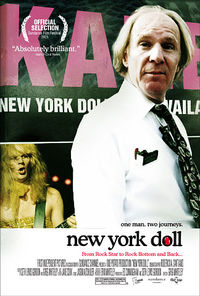
Here's a brief synopsis of the film:
This documentary film details the history of both The New York Dolls and one of its members, Arthur "Killer" Kane. The film narrates the history of the band from its formation in 1972, though its drug problems and the deaths of several of its members. The central focus of the film, however, is Arthur's life after conversion to The Church of Jesus Christ of Latter-day Saints after struggles with alcohol, drug abuse, and an attempt at suicide. As he struggles with both loneliness and poverty, Kane discovers that he will once again have a chance to perform with the Dolls in London.
And that's about all I feel should be shared without spoiling the movie's many surprises.
The movie is rated PG-13 "for drug content," which essentially amounts to a 1-2 second shot of a needle being inserted into an arm. Because of the small-scale distribution of this film, there is no Kids-In-Mind or Screen-It scorecard to report.
The marketing of this film when it hit DVD was nothing short of a tragedy. There are in fact two versions of the movie in circulation, each with a different yet equally horrendous cover.
The differences between the two versions in terms of content are that one "mutes" the 2-3 instances of mild bad language, and the other does not. Guess which one was marketed toward the LDS community?
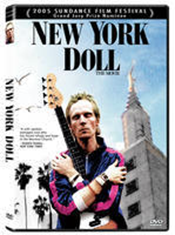
Yup, that one. What gave it away? Was it that photograph of the Los Angeles Temple poorly imposed in the background? And what's with the choice of the Arthur Kane photo? Are the cover designers implying that he's "gettin' holy" in front of the temple?
Well, the cover of the unedited version isn't that much better.
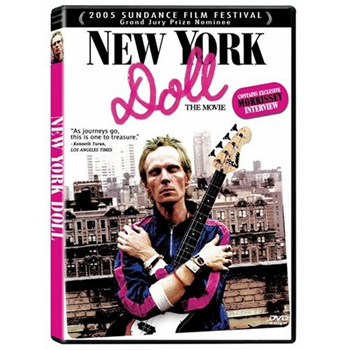
The content of the discs is otherwise the same, right down to the extras. The "sacred" version is available for sale at Deseret Book and other LDS-themed bookstores, while the "profane" version is available in all the other telestial marketplaces. Pardon me while I gag.
I bought the former version with some Deseret Book Rewards Points I had saved up (so it only cost me a few dollars), then printed out the original theatrical poster art and slapped in on top of the existing DVD cover so that I'd never have to look at that sixth-grade Photoshop chop job again.
But I digress.
The limited distribution of this movie in rental stores and libraries across the U.S. poses a bit of a unique challenge for us. Joel believes, and I agree, that this movie should be seen and enjoyed by as many people as possible, particularly LDS audiences who have grown weary of so-called "Mormon cinema" offerings like "The Singles Ward," "The Home Teachers," and "Church Ball." But seeing as this movie didn't exactly set the box office on fire, many markets don't offer it for sale or rent. We want everyone to see it, but we also want to stay on the right side of the copyright issue.
So here's what we're going to do.
If you would like to participate in this month's discussion (and you don't have a Netflix or Blockbuster Online subscription), please go to this site at Blockbuster.com, click "Check in-store availability," enter your Zip code, and see if any of your local Blockbuster stores have the title in stock. If none do, please comment on this post indicating your desire to watch the movie but a lack of rental availability in your area. We'll be setting up a mail distribution system to get you a (perfectly legal) copy of the disc, and you'll receive an e-mail message with all the details. You'll only pay the cost of mailing the disc to the next person, as well as the cost of an envelope, the combined total of which should be less than the cost of renting the film at Blockbuster anyway. The discs will eventually make their way back to the owner(s), who are "loaning" you their one legally allowable copy of the disc as a favor to you, their friends. :)
(Of course, you could always blind-buy a used copy of the movie from Amazon, starting at $4.59 plus shipping. You wouldn't be throwing your money away.)
This is our first time doing this, so consider it a beta trial for now. However, if we can make this work, it should open up a whole new realm of possibilities for Movie of the Month.
Okay, folks, that's it. Joel will be chiming in with a post on "NYD" in the future, and hopefully we'll have another great MOTM discussion on this overlooked gem.
Cheers!
Tuesday, March 25, 2008
Endorsed by the Last Man on Earth
For anyone who's seen "I Am Legend" or its trailer, you may remember a brief shot of Will Smith's character Robert Neville browsing through the titles at his local video store. He approaches the checkout clerk (a mannequin) with this movie:
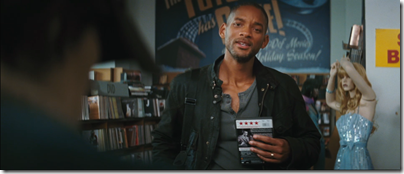 |
| "Mornin', Hank. Midway through the 'G's." |
Say, what's that movie he's holding? Let's take a closer look.
Why, that's the back cover of . . .
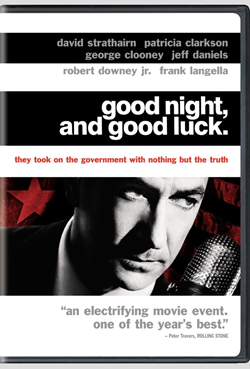
It's nice to know that not even a global viral holocaust can destroy good movies. And that Neville's got great taste in film. Actually, the title of the movie may be a subtle in-joke referencing his personal situation every night: "Good night, buddy. And good luck. Hope to see you again in the morning."
Saturday, March 22, 2008
Good Night, and Good Luck. (2005)
As the film begins, we are introduced to a cavalcade of journalists, network and advertising executives gathered together in a smoky banquet room to honor one of their own - and, in a way, themselves.
The year is 1958. Senator Joseph McCarthy has been dead for one year. His crusade to rid the country of supposed Communist elements is now four years past. It is a triumph for broadcast journalism, for the Columbia Broadcasting System, and especially for reporter Edward R. Murrow, the banquet's honoree.
But amid all the schmoozing and laughter, the picture-taking and merriment, Murrow is nowhere to be found.
We first see him in silhouette, nervously smoking a cigarette, as he waits backstage for his cue to come to the lectern and deliver the keynote address. After stepping to the microphone, he proceeds to deliver an unbridled castigation of his audience for the manner in which they are perverting the medium of television by using it to entertain rather than educate and inform.
Those first few minutes tell you everything you need to know about Edward R. Murrow.
George Clooney's Good Night, and Good Luck. (subsequently referred to as GNAGL) is a remarkably restrained telling of the Murrow versus McCarthy incident that played out in the living rooms of America during March-April 1954. At barely 90 minutes in length, there's little time given to establish the cast of characters (Murrow, McCarthy, newsman Don Hollenbeck, producer Fred Friendly, CBS executive Bill Paley, et al.) or go in-depth into the origins and events of McCarthyism. As a result, some viewers may feel a little lost. But although Clooney works hard to get the period details right, his objective isn't biographical. This is a movie first and foremost about ideas.
While campaigning to get the story of Milo Radulovich on the air, Murrow remarks in the film, "I simply cannot accept that there are, on every story, two equal and logical sides to an argument." Murrow was a man of conscience who felt a moral duty to editorialize his news reports for the audience. This led to his 30-minute See It Now special report criticizing McCarthy, which aired on March 9, 1954 (only a few minutes of which are depicted in GNAGL).
These days, reporters who editorialize the news are harshly criticized for doing so. In fact, there is a strong movement in newspapers and broadcast news today to erect a "brick wall" between the editorial section and the rest of the day's reporting. If McCarthy were alive today, most (if not all) broadcast journalists would elect to cover him by bringing him onto a show like "Meet the Press," together with analysts from both ends of the political spectrum, to question/harangue/defend him.
So, was Murrow's approach justified? As Paley says toward the end of the film (and I'm paraphrasing here), it was just a matter of time before McCarthy imploded, and the press would be there to record it. Couldn't Murrow have simply kept his opinions to himself, bided his time, then unloaded on McCarthy a few months later, after the infamous Army hearings? To put it another way, when do the demands of journalism require a reporter to lay down his or her sense of objectivity and take a stand for what's "right"? Or is there such a thing as "objective journalism"? Discuss.
The movie gets so many things right: filming in black-and-white; the use of jazz music interspersed throughout the film to establish tone; the lack of fancy camera moves, quick cuts, or other distracting gimmicks to pull the audience out of the story. Clooney was criticized by a few for his workman-like approach to the material, but I think his sparing style was the right choice.
I'd like to comment more particularly on two great elements of the film. First, the decision to use actual archival footage of McCarthy rather than hire an actor to portray him. The role of McCarthy would be an open invitation for an actor to really ham it up (think of Jack Nicholson's character in A Few Good Men, and imagine how he would deliver McCarthy's lines). Instead, Clooney allows the viewer to see this flamboyant individual as the rest of the nation saw him in 1954, an intriguing combination of blustery indignation and self-aggrandizement that is at once both funny and frightening to behold. For young people like myself who were not of his generation, it's amazing to comprehend that a man such as he (together with Roy Cohn) held this nation in terror's grip in the 1950s.
Second, David Strathairn's performance as Murrow is pitch perfect. Strathairn has always been a solid character actor, and as Murrow he never once chews the scenery or mugs for the camera. He plays Murrow as a man filled with fiery emotion but with the good sense to keep his composure. Note the look of disgust on his face after he concludes his canned "Person to Person" segment with Liberace. Or the way he allows Murrow's incisive invective to speak for itself:
We are currently wealthy, fat, comfortable and complacent. We have currently a built-in allergy to unpleasant or disturbing information. Our mass media reflect this. But unless we get up off our fat surpluses and recognize that television in the main is being used to distract, delude, amuse and insulate us, then television and those who finance it, those who look at it and those who work at it, may see a totally different picture too late.
The Academy Award for Best Actor in 2006 went to Philip Seymour Hoffman for his portrayal of Truman Capote (another reporter who became an active part of his own story, interestingly), but Strathairn was completely deserving of the nomination.
GNAGL is a tribute to Murrow's actions and ideas, but it is hardly a hagiography of the man. Toward the end of the film Paley notes that McCarthy said Alger Hiss was convicted of treason, and that Murrow did not correct him on-air (it was actually perjury), perhaps so as not to be seen supporting a known Communist. He has a good point. Murrow was a man of ideals, but he also knew when to play his conscience card. That scene in particular casts a slight shadow on Murrow's journalistic righteousness, but makes him more relatable as a human being.
Finally, one cannot escape the film's tie-in with today's political climate. Clooney is a fairly outspoken critic of President Bush and the war in Iraq, after all. I have not yet listened to his commentary on the GNAGL DVD, but I give him great credit for not making any overt connections in his film. Murrow's words in the film are entirely his own, nor is there any prologue or epilogue text drawing parallels to the present day. Like Arthur Miller, whose play The Crucible stands alone without the connections to McCarthyism, GNAGL is an excellent chronicle of courage in the face of fear without allusions to our time. At the same time, making those connections provides great fodder for a lively discussion. :)
Announcing: Movie of the Month
I've had a little idea percolating in the back of my mind for a few weeks now. I don't know how well it's going to work, but the preliminary discussions I've had with a few friends about it have been pretty encouraging. And, seeing how it's the first day of a new month, I figured now was as good a time as any to give it a go.
The premise: Everyone's heard of the tried-and-true "book club" concept, where someone assigns a certain title for everyone to read sometime during the month, after which everyone in the club gets together to talk about the book - whether they loved it, hated it, slept through it, etc., as well as discuss any major themes or what have you.
Well, what if we took that concept, adapted it to be about movies, and did it online - like through a blog? Everyone who wants to participate could be a full-fledged administrator/contributor to the site, and we would rotate responsibility for selecting a movie and leading the discussion (in other words, writing the first post and moderating subsequent comments) each month among members of the group. And we can keep the discussion going as long as we like!
Subscribe to:
Posts (Atom)
